

Cisco MRA Replacement with WebRTC
March 19, 2026
Cisco Mobile and Remote Access Replacement for More Secure Remote Working
Cisco introduced Mobile and Remote access for more than a decade ago to help to enable remote users to be able to have communications with Cisco CUCM. There was one small issue; the client applications Cisco had were originally designed to be used on the local area network or via VPN. Therefore, Cisco Expressway was required to be deployed for Cisco Jabber desktop and mobile clients to operate without any VPN on the client side.
Challenges Around Cisco Jabber and Cisco Mobile and Remote Access
As the cybersecurity attacks get more and more sophisticated, having an application that uses SIP port on a public internet is a big security risk. SIP ports are well-known and get attacked regularly. SIP itself was not designed to be used on the public internet by the client applications. Therefore, many businesses are looking for alternatives to Cisco Jabber and Cisco Mobile and Remote Access.
How WebRTC Can Help
WebRTC is designed for a public internet use by the web-based and mobile client applications. Microsoft Teams, WhatsApp and many other solutions use WebRTC and only convert to SIP if needed. WebRTC does not utilise a fixed, well-known port to be vulnerable. Both WebRTC signaling which is HTTPS-Based and audio stream which is Secure RTP are encrypted.
Comstice WebRTC Solutions
Comstice offers desktop thick clients, Chrome Web Browser extensions , Cisco CUCM Mobile Apps,Cisco Finesse Mobile apps, Cisco Finesse Webphone gadget that uses WebRTC. WebRTC session then gets converted to SIP by Comstice WebRTC Gateway running on the client network or Comstice Cloud. The public part of the call is fully encrypted.
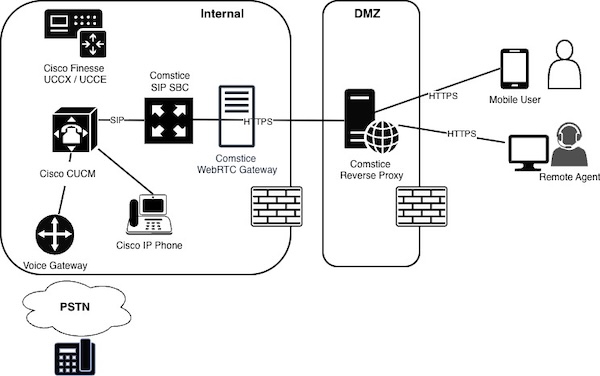
Comstice WebRTC Gateway converts the WebRTC call to SIP and registers the WebRTC session as a SIP endpoint into Comstice SIP Proxy / SBC. Comstice SIP Proxy has a SIP Trunk with Cisco CUCM. The WebRTC sessions do not directly register to Cisco CUCM due to some limitations and requirements on the Cisco CUCM SIP Signaling.
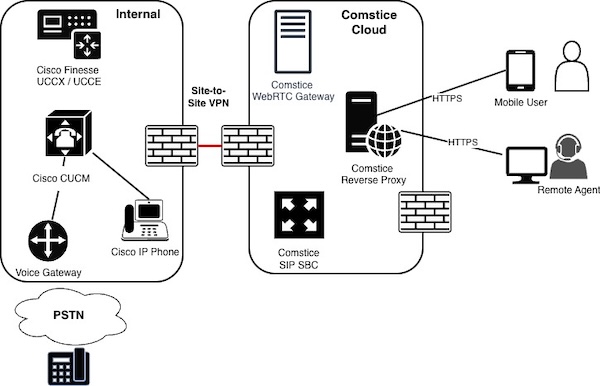
Comstice WebRTC solution can be hosted on-premises or in the Comstice Cloud as well.
Conclusion
Comstice Quartz has many dependencies to perform and